Showing posts with label prison. Show all posts

Wednesday, December 14, 2011

This Week's Podcast: Crime, Part I

Our weekly podcast series continues with its the performance of an interview conducted for Crime, USA: a new play exploring issues related to crime in America. This project is helmed by our Associate Artist and R&D Group member Alix Lambert. In her investigation for this project, she has interviewed lawyers, FBI agents, criminals, gang members, pawn shop owners, and more. This episode features actor Frank Harts as Antonio, a former gang member, talking about about the first time he got in a fight, the first time he carried a gun, his experiences as a gang member, and his life outside the gang. The material was recorded in our cabaret at Joe's Pub last year.

This episode contains some language and content that may not be appropriate for children under the age of 18.

TO SUBSCRIBE TO THE LET ME ASCERTAIN YOU PODCAST SERIES ON ITUNES, PLEASE CLICK HERE!

Friday, December 9, 2011

Simple Gifts

In September, Steve Cosson and a team of artists were in Colombia conducting research and interviews about the beauty pageant that happens every year in the national women's prison in Bogotá. They spent about three weeks talking to the women in the prison, including the participants in the pageant (one woman is selected to compete from each cell block), the women watching, past winners, the prison staff, and more. They learned a lot about both the pageant and day-to-day life for the inmates. One of the pretty striking aspects of the daily routine at the prison is that the women don't have easy access to some things that are pretty important to daily life, like toilet paper. There are two ways that the women can get toilet paper and other similar items: if they have money, they can purchase them from the prison store, but more often, the women will have a family member or friend who will visit once a week and bring them what they need. So those who don't have family nearby are left to figure out how to get this stuff on their own.

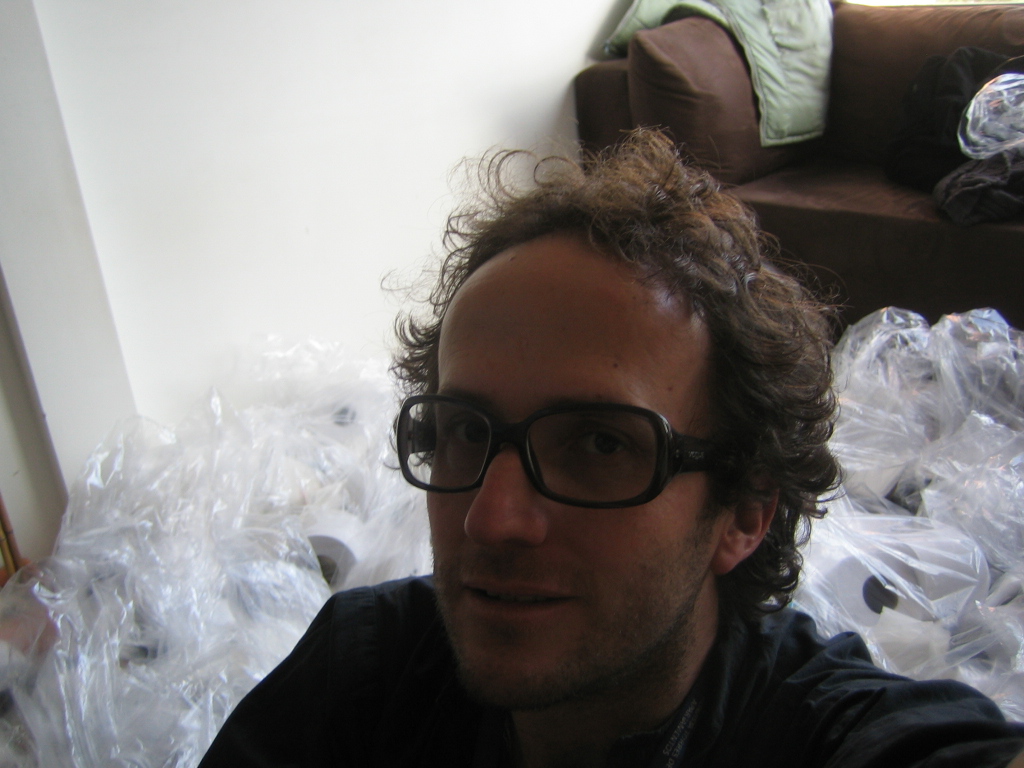
So Steve and the team went to the Bogotá version of Costco, where they raised some eyebrows by buying around 560 feminine napkins, hundreds of rolls of toilet paper and bars of soap, and lots of laundry soap and bocadillo (a Colombian guava candy).


They put divided up all the stuff into bags (each including two rolls of toilet paper and seven feminine napkins, plus the soaps and candy), and divided the bags by cell block for distribution.


As you might recall from earlier posts, it's not that easy to get into the prison. Each bag had to be individually checked by security before the team was allowed to proceed to the Education Building to distribute everything. Each interviewee and international inmate received a bag. To claim their bag, they got a piece of paper from the prison staff with their name on it. When their name was called by the prison staff, they were allowed to enter the courtyard, walk to Steve who was stationed in the center, hand Steve their slip, he would hand them their bag, and they would then proceed to exit the courtyard and return to the Education Building. The Japanese inmate, who didn't speak much Spanish, seemed pretty confused about the whole thing.


Check out the skyline in the background! 


And be sure to take a look at our photos posted this week on Flickr HERE of the pageant! Here's a few to whet the appetite - they're really incredible!

Check out the detail on this sequin work; it's  incredible!

Costumes are made from recycled materials.

From the folk dancing competition


Friday, September 30, 2011

Colombian Drug Trafficking

Steve and his team of artists have continued the process of conducting research and interviews for the BOGOTÁ PRISON PAGEANT at the national women's prison in Bogotá, Colombia. The women are in prison for many different reasons, but one of the more prevalent crimes is that of drug trafficking. In the movie "Maria Full of Grace," the mulas (women trafficking drugs - mules is the literal translation) swallow the cocaine in packages made of condoms. It seems that this method no longer works, since anyone suspected of carrying drugs is x-rayed at the airport.  Now the traffickers have ways of blending the cocaine into clothing, shoes, whatever. You can open a suitcase and everything looks perfectly normal, but then you'll find that all of the fabrics are actually made of drugs. Most of the mulas are paid and know what they're doing, but it does seem that some are tricked into carrying drugs. Apparently, one tactic in international trafficking is to send a group of mulas to the airport at the same time and set one of them up to get caught who is either knowingly or unknowingly carrying a smaller amount of drugs. The narcos pay off the police and the airport, and the set-up mula gets arrested with the smaller amount. The other mulas who've got the bulk of the stash pass through safely and fly off to deliver the goods.

In an interview with one of the mulas, she described this process to Steve and the artists, giving them one of their favorite lines:

"Cuando la policía detuvo, me sentía absolutamente ningún miedo. Solo pánico."

"When the police arrested me, I felt absolutely no fear. Only panic."

Thursday, September 15, 2011

Bogotá Prison Pageant: Intro to the Investigation

From Steve Cosson in Bogotá:

I've been here in Bogotá for a couple weeks now leading the investigation for our new Bogotá Prison Pageant show (working title of course. Saying that title out loud kindof feels like coughing).  I'm just now getting a chance to catch my breath – both literally and figuratively.  Bogotá is about a mile and a half up in the air which I'm aware of every time I have to climb stairs. The city is quite a metropolis—it stretches North and South with the Andes bordering the city on the East. The wealthier people live to the North, the poorer to the South. I'm living somewhere in El Centro which as you might guess is in the middle of the two – 31st street to be exact at the intersection of two main drags – Carrera 7 and 13. Carrera 7 is almost completely dug up with construction which is a big drag. Por ejemplo, last night jack hammers were working till about 1 am.  Apparently the construction had a lot to do with corruption and kickbacks of Bogotá's last mayor.  Which is part of why he is no longer mayor.

But why I'm here: I'm leading a group of 5 Colombian actors/theater artists in an investigation of the annual beauty pageant that takes place each year here at El Buen Pastor, a women's prison. Sadly there is no pageant at the men's prison.  After much to-ing and fro-ing with the national prison bureaucracy we got access to El Buen Pastor about ten days ago and the group has been visiting each morning conducting interviews with the inmates – some contestants some not.  El Buen Pastor has 9 "pavellones" or cellblocks.  Though a straight translation would be "Pavillion" which sounds much more fun.  It's really not a fun place. The beds are concrete slabs and often women sleep on the floor.  The prison was built to hold 1,000 and currently holds 1,800. Each cell just has bars on the windows so it's fairly exposed to the elements. Oh, did I mention Bogotá is COLD. Or at least for a cell exposed to the night air it gets down to 40 degrees. From these 9 pavellones there are 12 contestants.  Three of the pavellones are grouped together since the population of each is fairly small.  So from the six, a "reinita" or young queen and a "reina madre" or older/mother queen is elected. 

There's a lot of pressure on each of these women to compete and win, of course. But unlike a traditional beauty pageant the emphasis is on the group and not just the contestant. So each pavellon (aka patio) has to work together to build a float according to a theme, and a group of women from each patio learn a traditional dance and make costumes to accompany the presentation of their reinas.  

The theme this year is "the planet." As one of the psychologists of the prison told us, the administration wanted to raise awareness of environmental issues and global warming (see here for The Civilians play about all that). So of the six patios each is assigned a region of Colombia (determining their dance and costumes) and a planet-related theme:  air, water, fire, earth, living planet, dead planet.  We spoke to one of the queens having to represent the "dead planet" and initially she was fairly bummed at her patio's theme. I've been informed though that as of yesterday she figured out how to make a really killer outfit that's both glamorous and scary so now she is psyched.  

The theme is also key for the "Desfile de Carrozas," or the Parade of Floats.  Here for example are the carrozas for the National Miss Coffee pageant:  http://www.calarca.net/nacional/carrozas/index.htm 
(Did I mention that beauty pageants are a big deal here?  There's a pageant for just about any place, food, product or abstract idea you can imagine).  The carrozas at El Buen Pastor are a big effort – weeks of work to make spectacular floats out of shopping carts, recycled materials and some paint. 

I'm hoping by the time of the Desfile de Carrozas that I'll get permission to take photos.  So far no luck there.  

Here however, are a couple photos of our team of interviewers waiting to enter the prison. This is a fun ritual they get to do every morning at 8AM.  In future blog postings I'll be introducing you to the Colombian Civilians.  

Un abrazo!